Showing posts with label Thrillers. Show all posts

Monday, 10 April 2017

Insomnia isn't always a bad thing...

This morning I woke up at three am. I had a plane to catch to Rome, so maybe that was it. But I wasn’t due to get up until 5:45. I tried to sleep for an hour or so, and then it happened, as it sometimes does. My brain started typing.  A line. Not just any line. A killer line.

When trained killers enter a dark, smoke-filled room hunting their quarry, they don’t usually look up to the ceiling.

Damnit. The next line typed itself without even asking permission.

Which was exactly where Blue Fan was,

Screw it. I got up, pulled on some clothes and headed to the kitchen, switched on the kettle, made tea, and fired up the laptop.

hands and feet wedged hard against the edges of a recess, as if crucified on an X-shaped cross. Like a sacrifice. Which is exactly what she’d have been if they’d tilted their necks upwards. But they didn’t.

I stared at the words, sipped my tea. Okay, good tension. But what about her? This is the first time the readers of 66 Metres and 37 Hours meet Blue Fan, Nadia’s new nemesis. So, some character. Out-and-out baddie? No. Something more subtle, ambiguous.

Muscles taut, not breathing, she counted the rifle-sight laser beams criss-crossing the empty chamber. Three. Disappointing. She was worth more.

I carried on writing and editing. I’d already written the start of the third Nadia book two weeks earlier. But unless something better comes along, I know this will replace it.


As I typed the last line of the scene and hit save, the alarm went off.  Time to go to work, to catch the plane to Rome, even though part of my mind was still in Hong Kong with Blue Fan. What would be her next move?

Sunday, 19 March 2017

There are three types of shark...

I've had a fascination - and slight fear - of sharks ever since I watched Jaws, and then began diving. I've been lucky enough to dive in some pretty exotic places over the years, and have had some close encounters with hammerheads, blue sharks, silvertips, bull sharks and a tiger. Never a great white. Not sure I want to see one of those...

Sharks are finely-honed predators, and they can be pretty smart. I remember a bull shark in Sharm el Sheikh (Egypt) splitting off a female diver from the rest of our group, and herding her away from the reef out into the blue. She was fascinated by the shark, and didn't realise what was going on. It was a hell of a finning episode trying to get to her on the other side of side of the shark in order to rescue her.

I also remember being caught between two groups of four-metre hammerheads in Sipadan, at some considerable depth, and deciding that these were beautiful but completely scary demon-fish (okay, there may have been some narcosis involved). In Palau there is one of the best dives on the planet called Blue Corner, where the visibility can easily be fifty metres, and you can watch a dozen sharks hunting in the morning, zipping in and out of massive shoals of fish. While watching this spectacle, and clinging on to a rock because of the intense current, a shark sidled up to me, and came within arms' length, watching me with its beady eye. I had to decide what to do, so I let go, wondering if it would whip around and have a bite, but it just ignored me as the current swept me away. My buddy asked later, 'what took you so long to let go?'

In my latest diving thriller, 37 Hours Jake is a British diving instructor abroad on a tropical island, and here he explains how I feel about sharks, as he puts them into three simple categories, depending on whether they will run away from you, mawl you if provoked, or kill you if you're bleeding...

‘There are three types of shark.’

Jake was in dive instructor mode. Nadia wasn’t averse to it. He’d asked if she’d dived with sharks before, and she’d replied no. But she didn’t like being passive. She held up one finger, the second one, and gave him her blandest smile.

It didn’t put him off his stroke. Several other divers plonked themselves onto the bench. Dominic – the lanky, foppish-looking chief instructor – hustled his diving group over to listen. From his grin, clearly he knew Jake, and had heard this particular lecture before.

Jake caught Dominic’s eye, nodded, and continued. ‘First, there are reef sharks, about four feet long. They’re more afraid of you than the other way around, but they can nip you, if you harass them, or box them into a corner.’

‘How do you know if you’re harassing them? How close can you get?’ One of the British divers. The way he’d said it, it was a challenge.

Dominic tossed Jake a whiteboard marker. Jake neatly snatched it out of the air, turned to the whiteboard, and drew a crude side view of a shark with a thin body. He pointed to the pectoral fins. ‘These will drop down, move closer together, and…’ he sketched the same shark as seen from above ‘…the shark’s body will move from side to side.’ He added little arrows, and Nadia imagined the shark dancing, its body gyrating. ‘If that happens,’ he said, ‘back away fast.’

‘What if you’re in a cave?’ The dude again, pressing Jake.

‘Stick to the sides or the ceiling,’ Jake replied, zero antagonism in his voice. ‘Don’t block the entrance. Point is, even if they bite you, it’s a defence mechanism. They want to get away, or get you away from their nest. You can add to this class the slightly larger nurse sharks and leopard sharks, because they’re really not interested in us.’

Nadia held up two fingers, adding the forefinger, in a victory ‘V’, because he was winning this.

‘Second type is longer, six to eight feet, sometimes local, like grey reef sharks and black-tips, sometimes ocean-going – pelagic – like silver-tips. The first two are often in groups.’ He drew a longer and broader shark. ‘If you get cut around these sharks, they’ll attack, and the sheer numbers mean you won’t make it. Other predator fish like trevally, known colloquially as Jack, will arrive almost simultaneously, and all you’ll see is a whirlwind of silver, and every half-second one will dart in and tear off a piece of your flesh.’

‘Ever seen that?’ The Brit again.

Jake nodded to Dominic.

Dominic took a sip of his tea. ‘We occasionally do shark-feeding here, with chain-mail arm protection, using chum – that’s chopped-up fish intestines or heads – as bait.’ Several divers immediately sat up, their eager faces swivelling towards Dominic. He held up a hand. ‘Not very often, and only with advanced divers and instructors. It attracts the bigger ones to the reef, and they begin to associate humans with food, and then, as Jake already mentioned, there’s the trevally. They get pretty antsy. They’re just too unpredictable, too fast.’

Nadia added her ring finger.

Jake resumed. ‘Third are big, lone sharks. Bulls, tigers, the blue shark, and the great white.’

‘Ever seen a great white?’

This guy was a pain. Harmless, but a pain.

Jake didn’t take the bait. ‘There’s a saying amongst divers. The first time you see a great white…’ He flourished an open palm to Dominic.

‘Is the second time it’s seen you.’

Jake drew three flattened circles. ‘This is what you see when a shark is heading towards you. This one…’ he pointed to the reef shark ‘…can bite you. This one…’ he pointed to his type two ‘…can kill you, but it usually takes a few of them. And this one…’ He put down the pointer. Stared at the divers one by one. ‘Is out there. Fifty metres from where you’re sitting right now. If you swim away from the reef, just fifteen metres away, you’ll see him materialise out of the blue. A face, the mouth, the eyes. He’ll be coming straight towards you. It won’t be coincidence he’s heading your way. If this happens,’ he said, leaning forward on his knuckles on the bench, ‘DO NOT head for the surface. DO head straight back to the reef. NEVER lose sight of the reef. The really big sharks won’t approach the reef unless there’s already blood in the water.’

It was deadly quiet. Dominic grinned. The Brit piped up. ‘Bullshit. There’re no sharks that big just out there.’ Other divers turned to him, then to Jake.


‘You’re welcome to find out. We call it Anspida Roulette. See how long you can stay off the reef.’


In reality, we did play Sipadan Roulette (Anspida is an anagram of Sipadan), and that's where I saw my blue shark and a tiger, and swam like hell back to the reef. Needed a few beers later. In the book, though, since it's a thriller, there is a shark attack, as Jake is stabbed by another diver, so there is a lot of blood in the water. I'll save that for the book. It was quite a harrowing scene to write.

I'll still keep diving with sharks. Last time was two years ago in Mauritius, in the Passage St Jacques, with a dozen reef sharks in very murky waters. 

I think sharks are amazing creatures, and I'm still fascinated by them. But I'll never turn my back on them.


37 Hours is available here

Wednesday, 15 March 2017

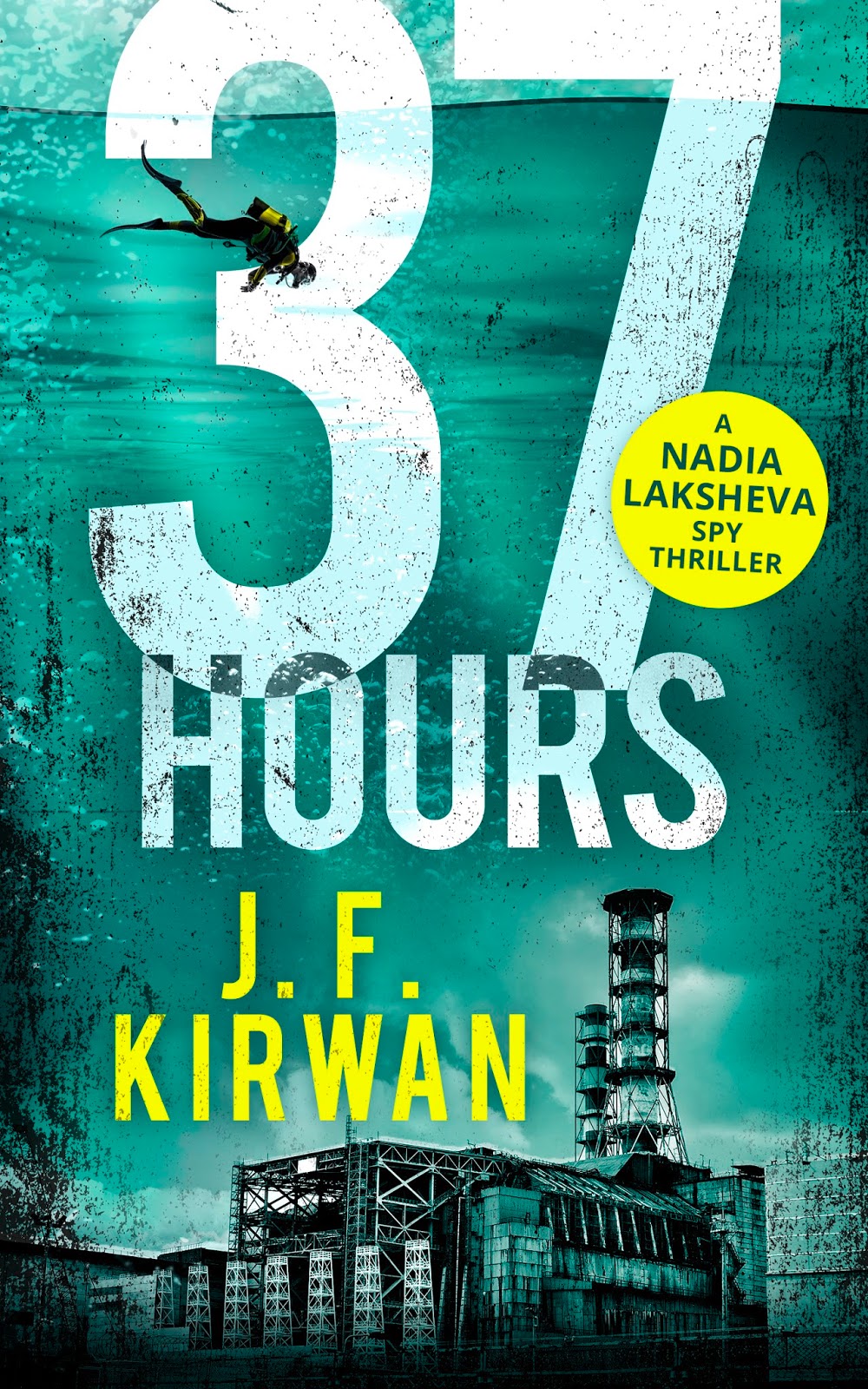
Why I wrote 37 Hours

Why did I write 37 Hours? Well first, of course, it’s a sequel. At the end of 66 Metres Nadia has succeeded, but the Client is still out there. In fact the first scene in Chapter One of 37 Hours was originally the epilogue to 66 Metres, but the editor and I decided to leave Nadia languishing in prison.  And so the readers demanded a sequel... 

But there were five other reasons.
  • Jack Reacher
  •  Diving a nuclear sub
  • Shark-attacks
  •  Chernobyl
  •  London

1. Jack Reacher


The title 37 Hours is a tribute to Lee Child’s book titled 61 Hours. This was the very first Jack Reacher book I read, and got me hooked and back into thrillers. I love the relentless pace and minimalist style, and how Jack is uncompromising. Of course Nadia isn’t Jack, but another character, Vladimir, is close, and the book starts with him in the Prologue. I’ve already had a number of readers tell me the book starts just like a Reacher novel. Couldn’t ask for more! Here’s the opening of 37 Hours:

Vladimir was cuffed and hooded, but his guards had made a fatal mistake. His hands were behind him, but not attached to the inner structure of the military van, a standard Russian UAZ 452 – he’d know those rickety creaks and the pungent blend of oil and diesel anywhere. The vehicle trundled towards some unknown destination where he would be interrogated, beaten some more, then shot in the back of the head.
Three of the four men chattered as they picked up speed down a straighter road. Their second mistake. Clearly they weren’t Special Forces – Spetsnaz – like he’d been until recently. They were regular army. He’d only seen the two heavies who’d snatched him from breakfast with his daughter. Now he knew there were four – one other had engaged in the banter, another had remained silent but was referred to as the butt of several bawdy jokes. The hierarchy of the men was also clear. The leader was in the front passenger seat, the silent one the driver, leaving the two musclemen in the back with him. He waited. They’d been driving for an hour or so, initially dirt tracks, now a highway, which meant they were on the E119 to Vostok. If they turned right, he had a chance, as they would have to cross the Volga River. Then he would make his move.
If they turned left, he was a dead man.
Vladimir wasn’t one for options, or for hedging his bets. Not a question of making the right choice, but of making the choice right. In all his missions he’d never cared much for a Plan B. Leave too many options open, and events control you. You invite failure.
            The van would turn right.

2.  Diving a submarine

66 Metres covered a lot of diving aspects, but there were two I hadn’t touched. The first is diving a submarine. The first time I did this was the M2, a submarine wreck off the Dorset coast near Weymouth. There is something stunning about coming across a submarine underwater, like a giant metallic whale. I tried to capture the way I felt in chapter three, when Nadia comes across a hijacked Russian nuclear submarine:

They hit thirty-five metres and levelled off. Still she saw nothing, but the sleds both slowed, and then she saw why. The forward light picked up the huge black tail-fin of the Borei Class nuclear sub, like the fin of a shark, which happened to be the nickname for this class of sub. Sergei’s sled circled behind, his forward beam illuminating the massive propeller. She tried to gauge how long each blade was. Maybe three metres.
           Sergei took point again, and fired a flare that fizzed forward like a lazy yellow firework. The sub was one hundred and seventy metres long, only slightly shorter than its predecessor, the Typhoon. But seeing it, positioned at one end while the flare swept forward over its dark beauty, was something else. The flare continued its arc over the conning tower, all the way to the prow, her destination. The light faded and plunged them back into darkness save for the sled’s lights. But the after-image was etched onto her retinas. Russian subs didn’t really go in for names, they were usually referred to as Projects and given a number, but Sergei had told her this one was the Yuri Gagarin. He’d have been proud. 


3. Shark attacks

There were no sharks in 66 Metres, so I wanted to include them in the sequel. In the second part of the book, Nadia and Jake dive in the South China Sea off the coast of Borneo, on a remote island called Anspida, which is an anagram of one of my top 3 diving destinations in the world, and a place where you can encounter large man-eaters, as well as hammerheads. Some of the dive instructors there used to play a game (the diving equivalent of Russian Roulette), where you swim away from the reef, out into the blue, and wait for the sharks to find you. Here’s where Nadia gives it a try…

  She glanced back several times, the reef just in sight, somewhere between fifteen and twenty metres away. Jake kept them at the same distance, two divers in perfect orbit around the island, two thousand feet of ocean beneath them. She stared straight ahead, into the blue. The sun’s rays lasered through the water, playing tricks on her brain. Several times she thought she saw something, and her heart skipped a beat, but it was nothing.
And then it came for real. A shadow at first, morphing into a blue nose, the curved line of its mouth, its eyes, and its pectoral fins, outlining an ellipse just like in Jake’s drawing. If it opened its mouth she would fit inside. Fifteen metres away, closing. Not on a swing-by. Coming straight at her. Ten metres. It was massive, she could now see the dorsal fin and her brain extrapolated the rest; it was easily five metres long. Its pectoral fins dropped, its mouth opened a little, revealing racks of backward-sloping teeth...

The actual shark attack scene which comes a little later, was hard to write. Mostly sharks leave people alone. But if you’re bleeding in waters like these, you’re in serious trouble. As a diver, even now when I read the scene in 37 Hours where two lives are claimed in a feeding frenzy, my blood still runs cold.


4. Chernobyl

I used to work in the nuclear industry, trying to make it safer. Chernobyl was such a shock to the world at the time, but I was also impressed by the heroism of the soldiers and others who worked manically to contain the radiation leak after the initial explosion, many of whom died shortly after from radiation poisoning, or later from cancers. There was also the lesser known story of heroism concerning shutting off an underwater valve to prevent a secondary explosion which would have re-opened the wound and irradiated half of Europe. This story was part-truth, part myth, and I included it as a story-within-a-story. It was the motivation behind the original title of the book, which was to be ‘One-Way Dive.’ And so the third part of the book takes place in Chernobyl, in Reactor 4. I was really pleased when the publisher decided to put Chernobyl on the cover.


5. London

I live in Paris, which is a great city, but I still miss London where I used to live. When writing a thriller, you have to put what the hero/heroine values most on the line. Nadia is Russian. London isn’t her city. But, to an extent, it’s mine, and I care about it. London is where 66 Metres started, and it’s where 37 Hours ends. In the final chapter, when the 37 Hours has almost run out, there’s a short scene where London is almost a character, one that Nadia wants desperately to see one last time. I think that scene, only a couple of paragraphs, is one of the most powerful I’ve ever written, and as an ex-Londoner it chokes me up every time I read it.


That’s it. I wrote 37 Hours in six months. For me that’s very fast (I have a day job!). It poured out of me, demanding to be written. If you do read it, I really hope you get some of the same satisfaction I got out of writing it!

You can get 37 Hours from Amazon here, and it's also available in other digital formats. You can get 66 Metres here