Sunday, 19 March 2017

There are three types of shark...

I've had a fascination - and slight fear - of sharks ever since I watched Jaws, and then began diving. I've been lucky enough to dive in some pretty exotic places over the years, and have had some close encounters with hammerheads, blue sharks, silvertips, bull sharks and a tiger. Never a great white. Not sure I want to see one of those...

Sharks are finely-honed predators, and they can be pretty smart. I remember a bull shark in Sharm el Sheikh (Egypt) splitting off a female diver from the rest of our group, and herding her away from the reef out into the blue. She was fascinated by the shark, and didn't realise what was going on. It was a hell of a finning episode trying to get to her on the other side of side of the shark in order to rescue her.

I also remember being caught between two groups of four-metre hammerheads in Sipadan, at some considerable depth, and deciding that these were beautiful but completely scary demon-fish (okay, there may have been some narcosis involved). In Palau there is one of the best dives on the planet called Blue Corner, where the visibility can easily be fifty metres, and you can watch a dozen sharks hunting in the morning, zipping in and out of massive shoals of fish. While watching this spectacle, and clinging on to a rock because of the intense current, a shark sidled up to me, and came within arms' length, watching me with its beady eye. I had to decide what to do, so I let go, wondering if it would whip around and have a bite, but it just ignored me as the current swept me away. My buddy asked later, 'what took you so long to let go?'

In my latest diving thriller, 37 Hours Jake is a British diving instructor abroad on a tropical island, and here he explains how I feel about sharks, as he puts them into three simple categories, depending on whether they will run away from you, mawl you if provoked, or kill you if you're bleeding...

‘There are three types of shark.’

Jake was in dive instructor mode. Nadia wasn’t averse to it. He’d asked if she’d dived with sharks before, and she’d replied no. But she didn’t like being passive. She held up one finger, the second one, and gave him her blandest smile.

It didn’t put him off his stroke. Several other divers plonked themselves onto the bench. Dominic – the lanky, foppish-looking chief instructor – hustled his diving group over to listen. From his grin, clearly he knew Jake, and had heard this particular lecture before.

Jake caught Dominic’s eye, nodded, and continued. ‘First, there are reef sharks, about four feet long. They’re more afraid of you than the other way around, but they can nip you, if you harass them, or box them into a corner.’

‘How do you know if you’re harassing them? How close can you get?’ One of the British divers. The way he’d said it, it was a challenge.

Dominic tossed Jake a whiteboard marker. Jake neatly snatched it out of the air, turned to the whiteboard, and drew a crude side view of a shark with a thin body. He pointed to the pectoral fins. ‘These will drop down, move closer together, and…’ he sketched the same shark as seen from above ‘…the shark’s body will move from side to side.’ He added little arrows, and Nadia imagined the shark dancing, its body gyrating. ‘If that happens,’ he said, ‘back away fast.’

‘What if you’re in a cave?’ The dude again, pressing Jake.

‘Stick to the sides or the ceiling,’ Jake replied, zero antagonism in his voice. ‘Don’t block the entrance. Point is, even if they bite you, it’s a defence mechanism. They want to get away, or get you away from their nest. You can add to this class the slightly larger nurse sharks and leopard sharks, because they’re really not interested in us.’

Nadia held up two fingers, adding the forefinger, in a victory ‘V’, because he was winning this.

‘Second type is longer, six to eight feet, sometimes local, like grey reef sharks and black-tips, sometimes ocean-going – pelagic – like silver-tips. The first two are often in groups.’ He drew a longer and broader shark. ‘If you get cut around these sharks, they’ll attack, and the sheer numbers mean you won’t make it. Other predator fish like trevally, known colloquially as Jack, will arrive almost simultaneously, and all you’ll see is a whirlwind of silver, and every half-second one will dart in and tear off a piece of your flesh.’

‘Ever seen that?’ The Brit again.

Jake nodded to Dominic.

Dominic took a sip of his tea. ‘We occasionally do shark-feeding here, with chain-mail arm protection, using chum – that’s chopped-up fish intestines or heads – as bait.’ Several divers immediately sat up, their eager faces swivelling towards Dominic. He held up a hand. ‘Not very often, and only with advanced divers and instructors. It attracts the bigger ones to the reef, and they begin to associate humans with food, and then, as Jake already mentioned, there’s the trevally. They get pretty antsy. They’re just too unpredictable, too fast.’

Nadia added her ring finger.

Jake resumed. ‘Third are big, lone sharks. Bulls, tigers, the blue shark, and the great white.’

‘Ever seen a great white?’

This guy was a pain. Harmless, but a pain.

Jake didn’t take the bait. ‘There’s a saying amongst divers. The first time you see a great white…’ He flourished an open palm to Dominic.

‘Is the second time it’s seen you.’

Jake drew three flattened circles. ‘This is what you see when a shark is heading towards you. This one…’ he pointed to the reef shark ‘…can bite you. This one…’ he pointed to his type two ‘…can kill you, but it usually takes a few of them. And this one…’ He put down the pointer. Stared at the divers one by one. ‘Is out there. Fifty metres from where you’re sitting right now. If you swim away from the reef, just fifteen metres away, you’ll see him materialise out of the blue. A face, the mouth, the eyes. He’ll be coming straight towards you. It won’t be coincidence he’s heading your way. If this happens,’ he said, leaning forward on his knuckles on the bench, ‘DO NOT head for the surface. DO head straight back to the reef. NEVER lose sight of the reef. The really big sharks won’t approach the reef unless there’s already blood in the water.’

It was deadly quiet. Dominic grinned. The Brit piped up. ‘Bullshit. There’re no sharks that big just out there.’ Other divers turned to him, then to Jake.


‘You’re welcome to find out. We call it Anspida Roulette. See how long you can stay off the reef.’


In reality, we did play Sipadan Roulette (Anspida is an anagram of Sipadan), and that's where I saw my blue shark and a tiger, and swam like hell back to the reef. Needed a few beers later. In the book, though, since it's a thriller, there is a shark attack, as Jake is stabbed by another diver, so there is a lot of blood in the water. I'll save that for the book. It was quite a harrowing scene to write.

I'll still keep diving with sharks. Last time was two years ago in Mauritius, in the Passage St Jacques, with a dozen reef sharks in very murky waters. 

I think sharks are amazing creatures, and I'm still fascinated by them. But I'll never turn my back on them.
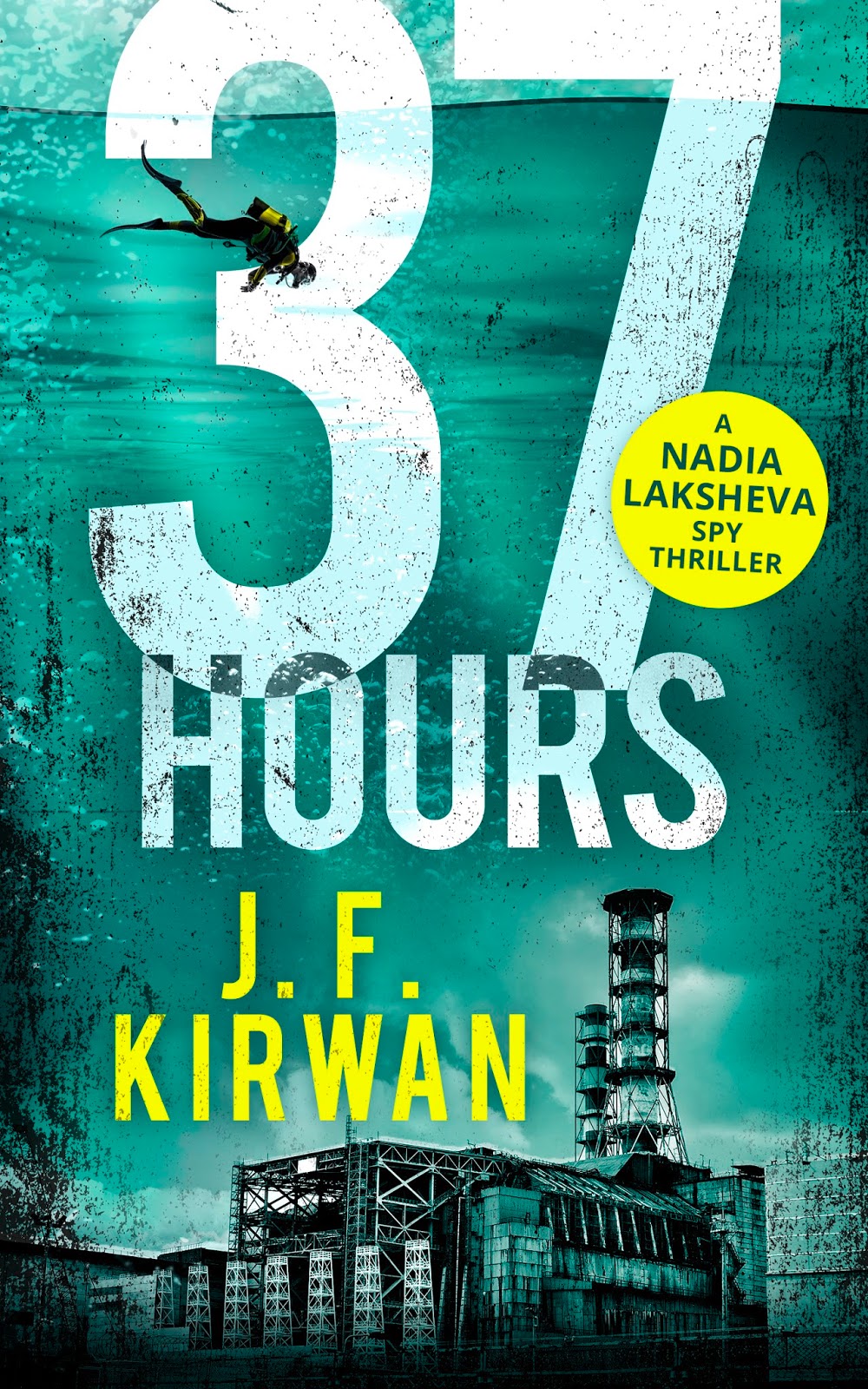

37 Hours is available here

Wednesday, 15 March 2017

Why I wrote 37 Hours

Why did I write 37 Hours? Well first, of course, it’s a sequel. At the end of 66 Metres Nadia has succeeded, but the Client is still out there. In fact the first scene in Chapter One of 37 Hours was originally the epilogue to 66 Metres, but the editor and I decided to leave Nadia languishing in prison.  And so the readers demanded a sequel... 

But there were five other reasons.
  • Jack Reacher
  •  Diving a nuclear sub
  • Shark-attacks
  •  Chernobyl
  •  London

1. Jack Reacher


The title 37 Hours is a tribute to Lee Child’s book titled 61 Hours. This was the very first Jack Reacher book I read, and got me hooked and back into thrillers. I love the relentless pace and minimalist style, and how Jack is uncompromising. Of course Nadia isn’t Jack, but another character, Vladimir, is close, and the book starts with him in the Prologue. I’ve already had a number of readers tell me the book starts just like a Reacher novel. Couldn’t ask for more! Here’s the opening of 37 Hours:

Vladimir was cuffed and hooded, but his guards had made a fatal mistake. His hands were behind him, but not attached to the inner structure of the military van, a standard Russian UAZ 452 – he’d know those rickety creaks and the pungent blend of oil and diesel anywhere. The vehicle trundled towards some unknown destination where he would be interrogated, beaten some more, then shot in the back of the head.
Three of the four men chattered as they picked up speed down a straighter road. Their second mistake. Clearly they weren’t Special Forces – Spetsnaz – like he’d been until recently. They were regular army. He’d only seen the two heavies who’d snatched him from breakfast with his daughter. Now he knew there were four – one other had engaged in the banter, another had remained silent but was referred to as the butt of several bawdy jokes. The hierarchy of the men was also clear. The leader was in the front passenger seat, the silent one the driver, leaving the two musclemen in the back with him. He waited. They’d been driving for an hour or so, initially dirt tracks, now a highway, which meant they were on the E119 to Vostok. If they turned right, he had a chance, as they would have to cross the Volga River. Then he would make his move.
If they turned left, he was a dead man.
Vladimir wasn’t one for options, or for hedging his bets. Not a question of making the right choice, but of making the choice right. In all his missions he’d never cared much for a Plan B. Leave too many options open, and events control you. You invite failure.
            The van would turn right.

2.  Diving a submarine

66 Metres covered a lot of diving aspects, but there were two I hadn’t touched. The first is diving a submarine. The first time I did this was the M2, a submarine wreck off the Dorset coast near Weymouth. There is something stunning about coming across a submarine underwater, like a giant metallic whale. I tried to capture the way I felt in chapter three, when Nadia comes across a hijacked Russian nuclear submarine:

They hit thirty-five metres and levelled off. Still she saw nothing, but the sleds both slowed, and then she saw why. The forward light picked up the huge black tail-fin of the Borei Class nuclear sub, like the fin of a shark, which happened to be the nickname for this class of sub. Sergei’s sled circled behind, his forward beam illuminating the massive propeller. She tried to gauge how long each blade was. Maybe three metres.
           Sergei took point again, and fired a flare that fizzed forward like a lazy yellow firework. The sub was one hundred and seventy metres long, only slightly shorter than its predecessor, the Typhoon. But seeing it, positioned at one end while the flare swept forward over its dark beauty, was something else. The flare continued its arc over the conning tower, all the way to the prow, her destination. The light faded and plunged them back into darkness save for the sled’s lights. But the after-image was etched onto her retinas. Russian subs didn’t really go in for names, they were usually referred to as Projects and given a number, but Sergei had told her this one was the Yuri Gagarin. He’d have been proud. 


3. Shark attacks

There were no sharks in 66 Metres, so I wanted to include them in the sequel. In the second part of the book, Nadia and Jake dive in the South China Sea off the coast of Borneo, on a remote island called Anspida, which is an anagram of one of my top 3 diving destinations in the world, and a place where you can encounter large man-eaters, as well as hammerheads. Some of the dive instructors there used to play a game (the diving equivalent of Russian Roulette), where you swim away from the reef, out into the blue, and wait for the sharks to find you. Here’s where Nadia gives it a try…

  She glanced back several times, the reef just in sight, somewhere between fifteen and twenty metres away. Jake kept them at the same distance, two divers in perfect orbit around the island, two thousand feet of ocean beneath them. She stared straight ahead, into the blue. The sun’s rays lasered through the water, playing tricks on her brain. Several times she thought she saw something, and her heart skipped a beat, but it was nothing.
And then it came for real. A shadow at first, morphing into a blue nose, the curved line of its mouth, its eyes, and its pectoral fins, outlining an ellipse just like in Jake’s drawing. If it opened its mouth she would fit inside. Fifteen metres away, closing. Not on a swing-by. Coming straight at her. Ten metres. It was massive, she could now see the dorsal fin and her brain extrapolated the rest; it was easily five metres long. Its pectoral fins dropped, its mouth opened a little, revealing racks of backward-sloping teeth...

The actual shark attack scene which comes a little later, was hard to write. Mostly sharks leave people alone. But if you’re bleeding in waters like these, you’re in serious trouble. As a diver, even now when I read the scene in 37 Hours where two lives are claimed in a feeding frenzy, my blood still runs cold.


4. Chernobyl

I used to work in the nuclear industry, trying to make it safer. Chernobyl was such a shock to the world at the time, but I was also impressed by the heroism of the soldiers and others who worked manically to contain the radiation leak after the initial explosion, many of whom died shortly after from radiation poisoning, or later from cancers. There was also the lesser known story of heroism concerning shutting off an underwater valve to prevent a secondary explosion which would have re-opened the wound and irradiated half of Europe. This story was part-truth, part myth, and I included it as a story-within-a-story. It was the motivation behind the original title of the book, which was to be ‘One-Way Dive.’ And so the third part of the book takes place in Chernobyl, in Reactor 4. I was really pleased when the publisher decided to put Chernobyl on the cover.


5. London

I live in Paris, which is a great city, but I still miss London where I used to live. When writing a thriller, you have to put what the hero/heroine values most on the line. Nadia is Russian. London isn’t her city. But, to an extent, it’s mine, and I care about it. London is where 66 Metres started, and it’s where 37 Hours ends. In the final chapter, when the 37 Hours has almost run out, there’s a short scene where London is almost a character, one that Nadia wants desperately to see one last time. I think that scene, only a couple of paragraphs, is one of the most powerful I’ve ever written, and as an ex-Londoner it chokes me up every time I read it.


That’s it. I wrote 37 Hours in six months. For me that’s very fast (I have a day job!). It poured out of me, demanding to be written. If you do read it, I really hope you get some of the same satisfaction I got out of writing it!

You can get 37 Hours from Amazon here, and it's also available in other digital formats. You can get 66 Metres here

Sunday, 29 January 2017

Write what you don't know...

About 18 months ago I was at the York Writer's Festival pitching my book 66 Metres to three agents, who all roundly rejected it. One of them took me aside, and said, 'Look, this book is about a young Russian woman. You're not Russian, you're not a woman, and let's face it...' He told me to write about what I knew. I decided to stick to my course instead, and a year later 66 Metres was published by Harper Collins.

But ever since that conversation, it got me thinking about the adage 'write what you know.' What about all those crime writers? Are they all murderers and serial killers in their spare time? What about science fiction writers? Do they all have spaceships locked away in their garages?

I like Lee Child's Jack Reacher series. To say I'm not alone is a whopping understatement. How does he convince the reader that this fiction could be reality? The answer is detail. Pick up any Jack Reacher book and what you see on every page is details that ground the book, as if you're there. You have the feeling that he knows his stuff. There is an authenticity about his writing. Not only is there information, it feels as if this is 'insider' information, the kind of info you don't find by simply clicking on Wikipedia. Take a look at the opening of Gone Tomorrow, the one I'm reading right now, and you'll see what I mean.

But even doing deep research can only get you so far. Reading and doing aren't the same thing. Sometimes you need to know what something feels like, physically and emotionally, or else you'll never draw the reader in.

When I had to write a scene where Nadia fires a magnum .45 in order to save her sister, I realized I'd never fired a handgun. I wrote the scene anyway, but even to me it seemed flat, false even. So I went to a gun range and did some basic training for a few hours, firing various pistols until we finally got to the big one. It is quite spectacular - the recoil is extreme, the muzzle flash is scary, and the noise absolutely deafening. It feels like you're firing a cannon. I rewrote the scene, put it at the start of the book, and arguably I think that very scene was what won over Harper Collins.

Of course there is stuff I do know a lot about - same goes for any of us - we all have deep expertise. Mine happens to be scuba-diving. So I can put details in there that only instructors know - little tricks of the trade they don't normally teach you. And I know what it is like to black out underwater, because it happened to me, as well as narcosis and close encounters with large sharks. Most readers say the book really comes alive and is most intense in the underwater sections.

Diving is also a big part of my motivation for writing this series. Although there are exceptions, often when I read thrillers where there is any diving at all, I wonder if the author has ever put their head underwater. The technical details are all off, and the experience doesn't ring true. I guess they
get away with it because most readers have never dived either. But I'd like to set the record straight.

But back to the agent's comment. First, I'm not a woman, and the protagonist (Nadia) is. I based her on a blend of a fictional character and a real - and somewhat exceptional - woman I know. Nadia is not very girly, and is to some extent the son her father never had but always wanted. I do admit I had to talk to some women to get the sex scenes right, as men and women really don't see things the same way when it comes to sex.

Second, I'm not Russian. I spent some time diving with Russians in Egypt a few years ago. I was the only non-Russian in the resort. They took me in and I got to understand them a little. I also met someone who was almost certainly Russian Mafia. I have a lot more work to do on this, I freely admit, but I now have a fascination with Russia and Russians.

Third, I'm not as young as I used to be. Okay. But I still think that way...

So, can you write what you don't know? Yes, but you need to blend it with something you do really know about. Then you're more likely to have the reader give you the benefit of the doubt about the part you don't truly know.

My next book, 37 hours, comes out 17th March, and is set in four locations: Murmansk, a remote island off the coast of Borneo, Chernobyl, and London. It involves diving a submarine, a stolen nuclear weapon, a vicious shark attack, advanced interrogation techniques, and radiation poisoning. Do I know about these things? Strangely, more than you might think. I wasn't always a writer...


[P.S.> a reader who recently read the prologue to 37 hours commented that it read like a Jack Reacher novel. I don't actually think mine is to the same standard, but I couldn't ask for more!]


Sunday, 15 January 2017

On being drunk underwater - nitrogen narcosis

You know that feeling when you're blissfuly happy, and you feel super-confident? Maybe you're in love, or high on something? Well, you can get that feeling easily when scuba-diving underwater. It's called nitrogen narcosis - the narcs - and it can get you killed...
First the basics. When you're diving with air in your tank, you don't normally get it above 30 metres (100 feet). Below that depth, the partial pressure of nitrogen starts to affect our brains, and it's very much like getting drunk. One of my most memorable dives was diving to 50 metres in Indonesia with a large school of tuna. I had the narcs for sure. and actually felt like I was a tuna. I swam with the school, turned when they turned, and was on the watch-out for sharks. My buddy stayed at 40 metres, watching me (in hindsight, not much of a buddy, no chance of rescuing me if i'd have gone deeper). 

When you get the narcs you believe you can go deeper. Then the narcosis will increase. The happy-go-lucky feeling can then change into panic and disorientation. I used to train divers to show them what it was like. I'd get them to tie a knot called a bowline on land, next to a quarry filled with water. They'd do it easily, without really having to think about it. Then we'd descend to 30 metres - the bottom, as it happens - and after five minutes I'd ask them to tie it again. They couldn't. Then they'd start laughing, and it would be time to go up. 

If you dive a lot, you get a kind of immunity, as your brain adapts. This is what divers call doing 'build-up' dives. If you do a couple of dives at twenty, then twenty-five, then probably 30m will be no problem. But you have to watch the signs. One of the golden rules in diving is 'Plan the dive, and dive the plan.' This is because on land you're stone cold sober, whereas underwater you might decide to change the plan, and maybe it's not such a good idea. 

There's even a sign between divers to let someone know you have the narcs. You point your index finger to your temple, and then draw a circle. If your buddy gives you this signal, you should go up. Often you don't need to go to the surface, maybe ascend just 5 or 10 metres and suddenly your mind will be perfectly clear as again. But if you ignore it. well... It is like getting drunk. There's a period when you realise you are getting drunk, and have the choice to stop drinking. If you don't, you tend to think you are no longer drunk, and that you are actually making perfect sense... 

Here's an extract from 66 metres, where the heroine, Nadia, gets narcosis. She's an experienced diver, and should know better, but she's under stress: she has to retrieve an object called the Rose, at 66 metres, or the Russian Mafia will kill her sister...   


Ben shut off the engine completely, the world suddenly silent barring the slip-slops of wavelets against the hull. ‘The prow is directly beneath us, at twenty-five.’

Jake nodded, squirted a little liquid soap into his diving mask, smeared it round with his finger, then leant over the rubber tube and rinsed the mask in seawater. Nadia did the same, looking into the green-blue water below, knowing the Rose was down there, waiting for her. Maybe she could retrieve it today. Why the hell not? Ben opened both their tank valves fully, then she and Jake sat on opposite tubes facing each other, masks on, regulators in their hands.

‘We stop at the prow,’ Jake said. ‘To check we’re both okay. Do you want to go inside the wreck?’

She didn’t. She wanted to plunge straight down to sixty-six, grab the Rose and come back up again. But he’d already said fifty was the limit, and she wasn’t dived up yet, and would get narcosis. Maybe if he went inside then she could go down alone…

‘Sure,’ she said.

‘Then stay close,’ Jake said.

Ben counted down. ‘One, Two… Three!’

She rolled backwards off the boat. The water hit the back of her neck and flushed into her wetsuit, warming up almost instantly. She sucked in a lungful of air and righted herself, and brought her head above the surface. Jake was already next to her. He gave her the OK signal then the thumb-down signal to descend. She returned them both in sequence, then held up her inflate hose and dumped air from her jacket. She sank beneath the water, the last airside view a rippled one of Ben leaning over the side of the boat, watching them disappear.

Jake dove down ahead of her, streamlined, occasionally twisting around effortlessly to check she was following. The water was featureless, and she felt like a parachutist dropping through green-blue sky. Keeping her breathing even, she cleared her ears every five metres or so, and studied his technique: Jake had his arms folded in front of him, the computer on his left wrist so he could read it, his right hand holding the inflate hose, jetting air into his stab jacket every seven or eight metres. Poetry in motion. She adopted the same position.

They fell through sheets of green-blue water fading to grey, the visibility about ten metres, the strong sunlight above gradually leached out by the depth. She couldn’t see anything ahead except Jake. Then a shape emerged, dark, pointed, big. Her heart rate kicked up a notch. Not everyone loved wreck diving. Some preferred ‘scenic’ dives with lots of fish. She didn’t get it. Wrecks were scenic and full of fish.

The prow of the Tsuba loomed out of the grey. A single spotted dogfish patrolled it while a small school of black bream hugged the sloping foredeck. Ben was good, he’d dropped them right on target. Jake slowed. She jetted air into her stab a little late. While he stopped centimetres from the rust-laden prow, hovering as if in space, she rammed it, and had to brace herself against it with outstretched arms. To recover, she let her momentum spin her body and legs around vertically, like a gymnast doing an underwater handspring, so she ended upright, one hand on the prow’s edge, the rest of her body parallel to the deck. As if she’d intended it that way all along.  

Jake gave her an appraising look, followed by the OK signal, which she returned. He then pointed to his air gauge. She looked at hers – one eighty bar – then showed it to him. He returned the favour. His was still at a pressure of two hundred atmospheres. Rule was, you surfaced when it got down to fifty bar, though she’d often left it much later than that. Jake aimed a flat vertical hand down the deck, and she started to descend the ship, tracing its steep seventy degree angle.

Good visibility wasn’t always best for a wreck dive. It was awesome to see an entire wreck underwater, but sometimes poor viz meant discovering a sunken ship bit by bit. The foremast emerged out of the grey. She glided in slow motion over two cargo holds, shining her torch down into them, illuminating a fog of tiny fish in one, rusted spare engine parts in another. The bridge beckoned, four steps and two metal railings inviting her inside. She turned to Jake and he nodded, so she went straight through the open hatch, careful not to bump the ragged metal sides, the rusty edges brilliant shades of orange in her torchlight.

The upper floor had almost completely eroded, so they finned up a few metres, and she found the helm, a classic antique ship’s wheel, most of the wood gone but enough of the brass fittings left to discern its original shape. Like any wreck diver she couldn’t resist grabbing it and staring out towards the mast, just visible. She realised she was grinning, and wondered if it was narcosis setting in. No, she was simply enjoying the dive.

Jake headed aft and she followed, descending deeper into the bowels of the ship.
Her thoughts became sluggish, as if she’d had a few vodkas. She watched his fins undulate in front of her as they entered a narrow black corridor. She could fin faster, show him how Russians dived. Without warning she kicked hard and thrust ahead of him like a torpedo. She misjudged it and her tank grazed the ceiling. She rebounded and ricocheted towards the floor. She let go of her torch to brace herself, and her hands disappeared into a thick layer of sludge coated with powdery sediment that plumed up in front of her mask. She could see nothing, and was still descending. Dammit, the walls were narrowing.

She tried to turn around, banged her head against solid iron. Shit! She couldn’t think straight. Panic rose in her chest, her breathing loud in her ears. Her torch hit the side of her head, its light lost in the black sediment, as if she was in a coal mine. Stop, dammit! Just stop moving. He’ll find you. But where was he? She tried to think. Had she turned left or right? Her breathing rasped ever louder in her ears.

Without warning she was tugged backwards sharply. Jake must have grabbed her fins. His hands pulled her around in the semi-darkness, her torch beam flailing wildly like a beacon in fog, still attached to her stab jacket by its thin cord.

Jake brought her close, right in front of his face, mask to mask. She breathed heavily. He put two straight fingers in front of her eyes, waggled them as if they were walking, shook his head once, then put them tight together, unmoving. She got it. Don’t fin.

He put an arm around her waist, just underneath her stab jacket, and kept eye contact with her. She had to fight her normal instinct to struggle free and be independent, which would only get them both into trouble. She stayed still. Jake edged them back out of the soup, pulling them along with one arm, and suddenly the water cleared, and they were back on the bridge. Her panic vanished. Narcosis was so depth-dependent: one second exhilaration, the next all-out panic, but a few seconds later and ten metres higher and her mind was clear as a bell. Jake studied her, and she nodded as if to say she was fine, gave him a clear OK signal to verify it, and he let her go. She followed him back outside the ship, and checked her air. Ninety bar. She showed it to him. He looked at it but didn’t show her his.

She’d blown it. Not nearly enough air left to go down to the sea floor and start searching, and in any case the narcosis would return straightaway. Fucking hell! The Rose was down there, waiting. She wanted to punch the wreck. But you can’t punch anything seriously underwater. At least she was alive. Next time she might not get narked at all.

Jake moved away from the Tsuba, and she followed him, close to an eel that slithered off in the direction of the underwater pinnacle propping up the wreck. She and Jake slowly ascended amongst lush green ferns, flora she normally spurned. Fish skittered over mossy boulders, and she tried to take her mind off this catastrophic dive. As they rose above the promontory, the prow of the Tsuba loomed into view again. A cuttlefish, changing colour mid-water, calmed her down a little. Her computer said she’d touched forty-eight metres, and required a decompression stop for five minutes, probably more by the time they arrived at six metres.

She gazed down the disappearing length of the ship. The Rose – her and Katya’s key to freedom – was down there, and she’d been less than twenty metres above it. 

It might as well have been a kilometer.


66 Metres available digitally everywhere. Please don't read your kindle or iPad underwater...

Tuesday, 3 January 2017

When is a novel finished?


This is a kind of zen koan - a mind-bending unanswerable question - for many authors. But as I'm getting ready to send off my next manuscript, these are the ten questions I ask myself:

  1. Prose - is it fresh, evocative, vivid, agile? Is it clean, with the occasional sparkle? Are the first five pages as good as they can possible be? Does it have a killer first line? Does the reader get a feel (or at least a hint) for the upcoming conflict in the first few pages?
  2. Characters - are they memorable? Do they each have their own voice? Does the protagonist undergo a change by the end of the book?
  3. Dialogue - is the dialogue sharp, never banal? Do characters interrupt each other? Do they occasionally say things that can't be taken back?
  4. Setting - are places described using all the senses, as perceived by (and reflecting) the characters' views of the world? Do settings imbue their own character on the novel (could it only happen there, or could it happen anywhere?) Do the settings signpost the mood(s) of the book?
  5. Pace - does every chapter advance plot and character? Is there a good pacing of action/drama, and dialogue/exposition/internal scenes allowing the reader to go deeper inside the characters, without ever becoming either too static (aka boring) or breathless? 
  6. Story - is the story coherent, every apparent loose end tied up, no deus ex-machina? Once the reader gets to the end, could she/he tell a friend what happened and why, and what it all means? 
  7. Genre - is it clear what genre it fits into, and what sub-genre? Does your novel follow the etiquette for that genre? [you have to read in your genre to know this]
  8. Motive - are you clear why you wrote it? Vanity and profit making are valid reasons. But if there is a part of you trying to come through in your writing, does the novel do you justice? Because it is personal.
  9. Essence - can you already boil it down to a handful of killer tweets? It's best to 'get' the essence of your novel before it's published.
  10. Cover - does the cover reflect the novel/s genre and essence? Because the cover matters.

Okay, back to my editing. I hope the above may interest or even help a few other writers.
JFK

Sunday, 25 December 2016

Xmas Teaser: 37 Hours

Happy Xmas everyone, especially to readers of 66 metres. Here's a teaser, the opening of the next book - 37 hours - due out in March. The book takes place in four locations: Moscow, a remote island off the coast of Borneo, Chernobyl, and London. Expect plenty of fast-paced action, gritty scenes, tough choices, a chilling villain, and some twists you won't see coming... 

This is how it starts. Some of you might guess who Vladimir is...

 
Prologue

Vladimir Nikolayevhich was cuffed and hooded, but his guards had made a fatal mistake. His hands were behind him, but not attached to any part of the inner structure of the military van. A standard Russian UAZ 452 – he’d know those rickety creaks and the pungent blend of oil and diesel anywhere. The vehicle trundled towards some unknown destination where he would be interrogated, beaten some more, then shot in the back of the head.

Three of the four men chattered as they picked up speed down a straighter road. Their second mistake. Clearly they weren’t Special Forces – Spetsnaz – like he’d been until very recently. Regular army. He’d only seen the two men who’d taken him from breakfast with his daughter. But now he knew there were four – one other had engaged in the banter, another had remained silent but was referred to as the butt of several bawdy jokes. The hierarchy of the men was also clear. The leader was in the front passenger seat, the silent one the driver, leaving the two musclemen in the back with him. One beside, one opposite. He waited. They’d been driving for an hour or so, initially dirt tracks, now a highway, which meant they were on the E119 to Vostok. If they turned right, he had a chance, as they would have to cross the Volga river. Then he would make his move.

If they turned left, he was a dead man.

Vladimir wasn’t a man for options, or for hedging his bets. Not a question of making the right choice, but of making the choice right. In all his missions in the past twenty years he’d never cared much for  a Plan B. Leave too many options open, and events control you, inviting failure.

The van would turn right.

He needed to know if there was anything, a metal strut, for example, between him and the driver, in front on the opposite side. Nobody had talked to him since his arrest. Why talk to a hooded, dead man? But they were military, at least they had been at one stage or another, so it should work. He waited for a pause in their talk fuelled by bravado – they were probably wondering which one of them would pop him in the skull. He had a feeling they’d make the driver do it. A rite of passage. Probably a rookie, not yet blooded.

The pause came.

“Cigarette?” he asked, nodding through his hood to the one opposite. “Probably my last, we all know that.”

Silence, except for the van’s suspension creaking. He imagined questioning looks from the musclemen to the leader, the driver fixing his eyes on the road, maybe a glance in the rear view mirror. The dead man had spoken.

A sigh, the rustle of clothing, a pocket unzipped, the tap-tap of a cigarette being flushed from the pack. He could smell the nicotine despite the strong diesel fumes. A hand heavy on his shoulder – the muscleman on the same side – while the hood was pulled up by the other one just enough. He felt cooler air on his lips, the stale coffee-breath of the one opposite.

The smack in the mouth wasn’t entirely unexpected, but it stunned him all the same. He slid off the bench onto the floor, and while three of the men burst out laughing, he stretched his left leg backwards towards the rear edge of the driver’s seat – nothing in the way, no vertical metal support. But there could still be a wire mesh separating the rear compartment from the two in the front. He rocked back onto his knees, and addressed the one who’d hit him. He lowered his head, bychit-style, a bull about to charge, and spat out the words amidst spittle and blood.

Mu dak, suka, blyad!

This time the punch was fully expected. He railed backwards and upwards, travelling with the force of the uppercut, so that his head ended up in the gap between the driver and the leader, which cost him a whack from the latter on the top of his head. No wire mesh. Rough hands slotted him back where he’d been twenty seconds earlier. Profanities poured forth. Nothing he’d not heard or said himself. His face stung. He ignored it. Things settled down, and the banter resumed.

He began drawing long breaths, oxygenating his body. He was chilled, because he had no coat. The other men were wrapped in thick commando jackets. It was early spring, still cold. The Volga would be near freezing, maybe four degrees. Not a problem, he bathed in it every morning. For them, though, it would be a different story.

The van slowed. The tick, tick, tick of the indicator. They slowed down further. Stopped. A truck passed fast ahead of them, rocking the high suspension van in its wake. The leader bellowed a command, though he wasn’t stupid enough to name the destination. “This way, this way.” Another lorry – no, a tractor, given the smell of manure – the leader cursing the young driver for not pulling out sooner. The engine revved, the gear engaged, the van pulled forward.

And turned right.
 
37 Hours is due out in March 2017
 
66 Metres is already out!
"Massive page-turner!" "This author knows his stuff!" "Intelligent, fast-paced thriller!"